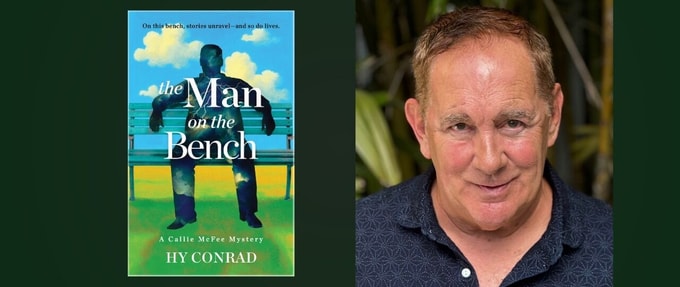
Hy Conrad has worn many hats in the mystery world.
He’s worked on mystery television shows, such as White Collar and The Good Cop, though he’s best known as a writer and co-executive producer on Monk.
He began his mystery career creating immersive mysteries on Laserdiscs, has written for murder mystery video games like Clue, and written solve-it-yourself mysteries and other books including Monk books.
He’s been nominated for three Edgars from the Mystery Writers of America for Monk and won the 2022 Independent Press Award for Best Mystery for The Fixer’s Daughter, the first novel in the Callie McFee series. He also won the 2022 NYC Big Book Awards for Best Mystery Series for the Callie McFee series.
The series features investigative reporter Callie McFee and her father, Buddy McFee, a powerful Texas fixer with dementia.
Conrad released the third book in the series, The Man on the Bench, earlier this year. We had the opportunity to talk to him about his Callie McFee series and his distinguished career.
This interview has been edited for length and clarity.
Murder & Mayhem: I read in an earlier interview that the idea about dementia came up in the writer’s room for Monk, but it didn’t get used. What was it that seemed so compelling to you to create a series around it?
Hy Conrad: In the writers room, someone said "Okay, what if you had someone who had all the big secrets, like a high-powered lawyer or a priest who had everyone's innermost secrets, and he began to get dementia. He might blurt things out and so people would want to shut him up and not want him to start blabbing about things 20 years ago.”
That led to the character of Buddy McFee. I wanted to set the book in a place that had a combination of old world political machinations and skullduggery and combine it with someone like Callie McFee, his daughter, who would be able to look at this old boy network [more critically].
That led me to the idea of Austin, which is both new Texas and old boy network Texas. That gave me the setting.
We have a Texas fixer and his daughter, who's a reporter, and it grew from there.
Where did you get the idea for The Man on the Bench?
The idea for this book is very specific. I had read an article about a homeless guy who would sit on a bench and talk to people.
During the morning rush, people would sit down, he would talk to them, and share their lives with him. He was a very friendly individual.
The one I read about was murdered, and it wasn't a big mystery. I think it was someone else in the homeless community.
But that got me thinking: “Okay, what if you have this very innocuous kind of friendly, self-effacing guy who everyone opens up to and chats with every day? What if he got murdered? What would be the motive? What would be the twist?"
That was the impetus right there, just from reading about this poor guy.
The Man on the Bench: A Callie McFee Mystery
How has the story evolved since the first book, The Fixer’s Daughter?
The first book was more about the father, Buddy. He is on one side of a murder investigation, and Callie's on the other.
In Sins of the Family, he botches a small case, and that gets Callie involved in trying to save his reputation. Buddy is still very much an active part of this mystery, even though he does physically very little in Book Three.
He is more on the sidelines, even if he does provide the impetus for some of the action.
I think each book is a little less about Buddy. Obviously his health is failing.
The feedback that I've gotten from a lot of readers is that they're more entranced with Callie than they are with Buddy.
He does a lot in Book One. The way the series is growing is that she is taking more of the lead and he's going more into the background.
What has surprised you about your characters?
A lot of the time, I will have a minor character, one that I think is going to be just there for exposition, like a page or two, and they will soon turn into a major character.
I will start with knowing how the story begins, and I'll know the twist, and I'll know the ending. But a lot of the stuff in between, I discover as I go along.
I was kind of surprised that Callie doesn’t have a lot of friends. I can't write her with a close friend.
I don't think she bears her soul to many people. I don't think she's that type of person; she's sort of a solitary figure.
You’ve written in several different mediums: games, tv shows, solve-it-yourself, and mystery novels. What challenges do you face writing in such diverse mediums?
It’s how things get done.
Writing] a book is very lonely. It’s one-on-one, a competition between you and the blank page.
TV [shows] are written by a committee.
I've written mysteries and other things for the Hallmark Channel, and they have a very specific way of doing their movies: “This has to happen by page 20. Your lead character cannot fool her love interest on purpose.”
[With Laserdisc and video games] they have always been [limited by the technology.] These scenes have to be three minutes long.
TV is much more of a visual medium. There are certain things that I can say in one paragraph of notes to the director that don't work on the printed page.
You have to work it out differently.
[For instance,] if you have an object that you want the viewer to notice for one second, and then you want them to forget it. You can write that in your script directions.
How you hide a clue is different on the printed page. You have to use your wits differently in order to conceal the mechanics of the story.


