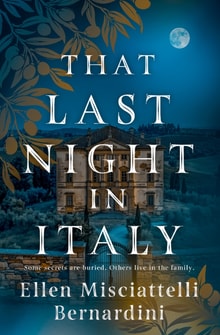
Ellen Misciattelli Bernardini is a luxury hospitality professional and co-owner of Palazzo Misciattelli, a historic boutique hotel in Orvieto, Italy. A lifelong lover of Italy and a former travel advisor, Ellen has spent two decades creating immersive experiences that connect guests with the country’s architecture, cuisine, art, and culture.
Her intimate knowledge of life inside an Italian palazzo, combined with her keen understanding of people and hospitality, brings an authentic perspective to her debut murder mystery, set within the beautiful landscape of a palazzo in the Italian region of Umbria.
In That Last Night in Italy, Dante Monaldeschi was just a child when his parents were murdered in an olive grove one night. Dante saw the whole thing happen—and the killer saw him.
The boy was issued one simple warning: never come back.
But after letting years pass, Dante decides it's time to ignore that warning and return to Italy at last.
In the village of Beltorre, he stands in the crumbling family palazzo and reunites with his dazzling cousin Amara and his beloved family dog, Apollo, who has a special knack for seeing ghosts. And together they begin to dig into a past no one wanted unburied.
There is so much more to the mystery than just familial tragedy—ancient artifacts have been stolen, and shady religious collectors will kill anyone in their way of these unique treasures.
And when a shocking secret comes to life, it not only brings the danger much closer to home, but the betrayal, too.
Read on for an excerpt of That Last Night in Italy, then purchase the book!
____________________

____________________
That Last Night in Italy
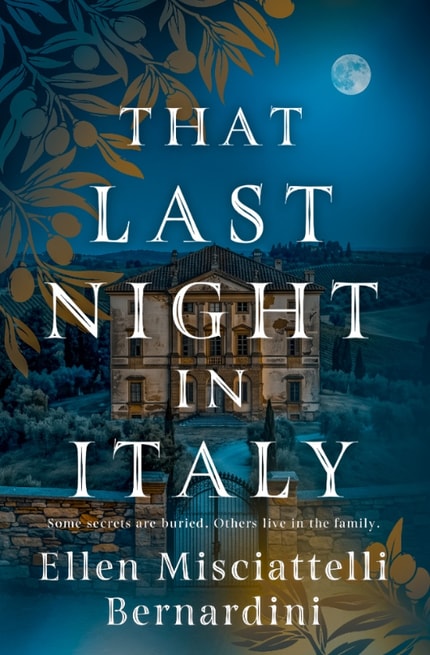
1 DANTE
It wasn’t easy being back.
It was Dante’s first time in Beltorre since the night of his parents’ murder all those years ago. The bright summer sun dizzied him. He stepped out of the car onto the hot sampietrini stones of the Umbrian piazza. He hadn’t slept much on the plane and was craving a dark room and sleep.
Beltorre, he thought as he looked around, the sound of the town’s name filling his mind like the taste of something he had known long ago.
He looked up at the double façade of the aristocratic palazzo towering four stories above him.
The blue side of the palazzo was his, which was the problem. A shadow of its former elegance, with broken windows, a sagging roof, shutters that had slipped from their grips at odd angles. The remnants of ancient Renaissance stone arched windows melded with neoclassical architraves, centuries of history woven together.
Pieces of roof tile lay shattered on the stone pavement below, where orange plastic cording kept pedestrians safe from debris.
Dante had wondered if Beltorre would feel like home, or like the nightmare it had become the night his parents were killed, when he was a child, torn away from everyone and everything he had known, when his aunt Beatrice had taken him to San Francisco, at the far edge of a far continent.
To safety, Bea had said.
Bea and Alex stood next to Dante in the piazza. Alex’s dark hair glinted in the strong Umbrian sun, his ready smile and pervasive optimism clouded in a slight frown as he looked around, studying the place which had caused Dante so much pain.
Bea put up her hand to shield her hazel eyes from the blazing August sun as she studied the palazzo.
“Palazzo Celeste, divided in two wings. The pale yellow Del Sole wing on the left, which is Bruno’s and Amara’s,” she said, indicating with her finger. “And the light blue Della Luna wing on the right, which is yours.”
Here in Beltorre, Dante heard Italian all around him from the townspeople passing by. While he could understand, the idea of forming Italian words on his lips felt impossible, treacherous. Italian was a world of peril he associated with the violent end of his childhood in Beltorre.
Dante swallowed as he looked up at the Palazzo.
The stone crest of a lizard hung above the ancient arched doorway, its worn features attesting to centuries of guardianship.
Alex glanced at Dante, smiling broadly to encourage him. “You remember it, don’t you?”
Dante’s mouth twitched. Yes, Dante remembered this place. He remembered Beltorre, its castle-like turrets, round medieval towers, and tall, imposing fortification walls with two steep valleys below.
He remembered how the tall stone houses stood shoulder to shoulder, only occasionally parting in small alleyways to let pass sun and wind and air. The cobblestoned central piazza contained a small grocery, two small cafés, a bakery, and a pharmacy. A three minute walk in any direction led to the edge of the town walls.
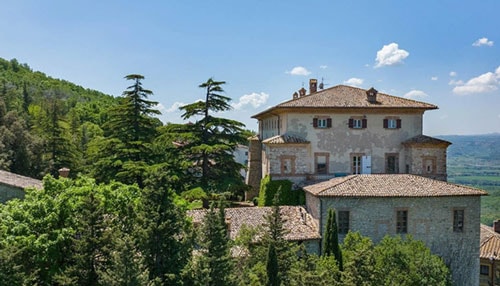
 Photo Credit: Francis York/www.francisyork.com
And Palazzo Celeste itself. He remembered everything in the map of his mind. He felt a wave of sadness as he thought of his parents. Clara and Gregorio laughing, his giant dog Apollo stretched out upside down at their feet. The grand rooms on the Palazzo’s piano nobile, the floor where for centuries the aristocratic family lived. How breezes passed from one end of the long house to the other, carrying the smell of Maria’s cooking. He remembered playing in the garden with his cousin Amara, collecting rocks and fossils and snails in the Italian sunshine.
He remembered how the stone stairs climbed and then divided left and right, where corridors led to the soaring central library. There, soft lush sofas were invitations to curl up and read, while stairs led to the topmost stacks.
Dante watched as a curtain fluttered in the yellow half of the palazzo. A pale face appeared in a shadow, then receded. Amara, he thought.
Memories fluttered like burnt sunlight. Dante remembered running panicked, through the moonlit Umbrian olive grove towards the cover of the forest. He had hidden underneath leaves, frozen with fear, his leg hurting badly. Later they told him that he, too, had been shot. Apollo found Dante under the brush, licking his face until he stirred, nudging him to get up.
“And they never found my parents’ killer,” said Dante.
It was a miracle Dante was even here, apart from surviving that night.
If he hadn’t found the letters, his life would have rolled along on its programmed path. A safe, simple, secure life, finishing graduate school by December. The past would have stayed buried and dark.
Maybe he even wanted it to stay buried.
But the letters had changed everything.
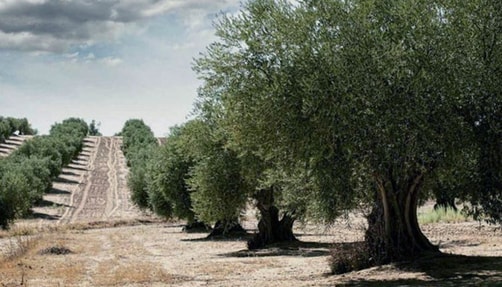 Photo Credit: margoimmobiliare.com
2 APOLLO
Basking in the sun streaming into the palazzo library, I sensed Dante’s presence. I knew he was coming back. I thumped my tail on the on the parquet floor. We dogs know well in advance the return of our masters.
When I heard Dante’s voice in the piazza, I knew for sure it was him. It was no longer that of a little boy, deeper now, but with the same relative frequencies and resonances.
I went to the window, putting my paws on the sill to look out. I wanted to see him, I wanted to go to him.
He had grown so much, but I recognized his smell. He had been so small when I’d last seen him, the night of the murders.
The night they had taken him away from me.
I had known immediately who killed Dante’s parents. Strong, unusual scents had hung in the night air.
Blood, brass, and the queer smell of human death.
Then the smell of Dante. Small and wounded, but alive.
3 DANTE
Dante was in Beltorre because of the letters.
The town’s name Beltorre was stamped in a formal, impersonal font. It had worried him. Gnawed at him. Beltorre.
Why had his aunt Beatrice hidden these letters from him?
He had confronted Bea. “I’m not a child anymore, Bea. I have a right to know these things.”
Bea took a deep breath. “When we came to San Francisco, you didn’t speak for a year, you couldn’t tell us anything. You played in silence with Alex. When you finally spoke, it was only in English.”
Bea paused and lowered her voice.
“You had been hunted, a witness who had survived. We hoped that here in San Francisco, so very far from Italy, you would be safe.”
Dante felt a primeval panic rise in the pit of his stomach. “From what danger? From whom?”
Bea pressed her lips together. “I have gone over it in my mind a million times. It could have been anyone. Hunters. Poachers. Tomb robbers. Jealous relatives. Jealous neighbors.”
She shook her head, frustrated. “There was never any meaningful evidence or proof released.”
“I need to go back. To Beltorre,” said Dante.
Bea was very still. She covered his hand with hers, resigned. “I have already lost everyone, Dante. I can’t lose you too.”
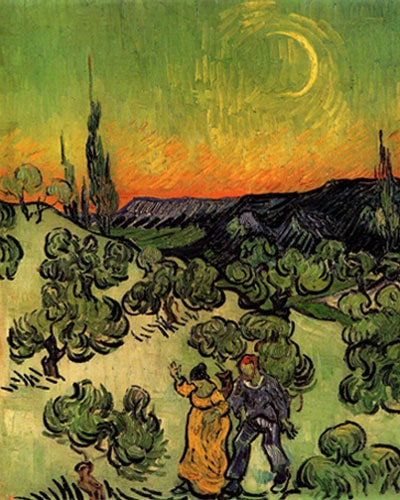 Photo Credit: myddoa.com
4 APOLLO
The night Dante’s parents died had started out as the most beautiful summer evening. A cool breeze was coming up from one of the deep valleys. Scents of summer grain, of wild boars digging up black truffle, of baby foxes venturing out for the first time, of sunflowers closing up for the day.
A half-moon illuminated the fields, the vineyards, and the olive groves. We walked, Clara and Gregorio to see the stars, Dante to hunt fossils, and me, because I went with them everywhere. They were my world.
The shots had taken me by surprise. Dante disappeared in the chaos of bullets. When everything fell silent, I had lain between the still warm bodies of Gregorio and Clara and waited. I was accustomed to death in the animal world.
But not this.
5 DANTE
Dante watched as Beltorre stirred to life. Several townspeople moved about, occasionally stopping to chat in the warm morning air. Two men stepped out of a pickup truck with a cage full of barking dogs and went inside the bar for an espresso.
Warm yeasty odors floated out of a little bakery and Alex peered inside curiously. Dante’s stomach rumbled. The baker Gazella was shouting at his worker, and only briefly stopped yelling to stare at the newcomers.
Dante remembered Gazella, and not in a nice way. Gazella had been in the olive grove the night of the murders. Gazella, the monster who haunted his nightmares.
Dante heard a car engine from down the Corso, the boulevard. An engine that was accelerating fast. Too fast. As the car came into view, they could see it was small and old, yet its hooded driver perfectly navigated the narrow Corso at high velocity.
“Hey,” called out Dante, waving his arms.
The car swerved directly towards Dante, a clear and targeted attempt to strike him. Dante leaped, landing hard on the church steps, yelping as he fell. The intensity of the pain took his breath away. The driver gunned the engine and took off down the one-way Corso towards the exit of town.
Dante sprawled on his side, groaning, as Alex reached him. “I’m calling the police. Yikes, that arm looks bad.”
An enormous tawny dog bounded through the piazza towards Dante. The dog began furiously sniffing and licking Dante, his huge golden tail wagging broadly.
A pale girl caught up to them.
“I’m terribly sorry. Wait…Dante?” the girl stared, her brown eyes incredulous. Dante recognized her immediately as his cousin Amara. And with her, his old dog, Apollo.
Dante nodded, squinting through the pain. “Amara. Apollo. I can’t believe it.”
The big orange dog stood over him, wagging his tail, and Dante felt the same sense of Apollo’s protection as he had on the night of the murders.
Police and others were filling the piazza.
Medics moved Dante into the shade.
“An old white Fiat Panda,” chimed in an onlooker. “With a crucifix hanging from the rearview mirror.”
The officer grimaced. “You know how many old white Fiat Pandas there are in Beltorre with crucifixes hanging from the mirror?”
The presence of Apollo by Dante’s side also stirred to life memories of the night of the murder.
Inside the ambulance enroute to the hospital, Dante remembered the night his parents were killed. It filled his mind like a technicolor film. And it terrified him.
7 APOLLO
The last time they had put Dante in an ambulance, he was so much smaller. The rest was all the same. His eyes squinting in pain. The blood, the police, the fretting relatives holding me back. He remembered me. I hoped he had forgiven me, that I couldn’t save his parents, that I had no way to tell him who the murderers were. But I knew who to protect him from.
In these years, his scent had deepened and intensified but he was still my boy.
Humans cannot understand the olfactory world of dogs. Amara says I have hundreds of millions of sensors in my nose, while people only have six million. I don’t know how much that is, but Amara seems to think it is a lot.
I can detect odors from many kilometers away. Shepherd dogs running free in the fields, hunting dogs locked in their cages. Cats stalking mice in ruined villas, pheasants hiding in perfumed yellow ginestra bushes, white cattle moving to the high hills in summer. In the warmer months I can smell the lucertole, the little lizards. These are fun to hunt and chase so I am acutely attuned to their presence.
I can smell the Umbrian white truffles in the winter, and black truffles of all types in the summer, the hard buds of roses that haven’t yet bloomed, the deep roots of the olive trees. I can smell little snails in sandy soil, I find them delicious. I can smell the remains of baby cinghiale inside the excrement of the lupo, the wolf. And I know chillingly well the smell of the wolf itself, its odors of ancient primality, feral wisdom, and cold strategy.
As I stood next to Amara watching as they took Dante away again, I picked up another smell in the hot air drifting through the piazza. It was a person I knew well, a troubled person, but one to whom I owed my life.
It was Alfio. Alfio, who smelled of fear and grief, of the farm and the favetta field beans thrusting through the mineral-hard clay and turning his boots white.
Alfio was back in Beltorre. Alfio is always present when needed.
And that’s why I worried.
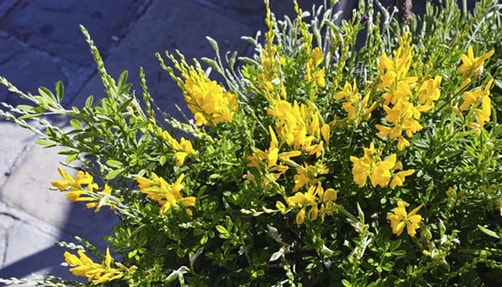 Photo Credit: www.gardeningknowhow.com
8 ALFIO
The smooth wood grip of my rifle felt sticky with sweat and humidity. I peered into the piazza through the slats of the closed shutters. I had come to protect the family to whom I owed everything.
I hadn’t expected the car attack. It happened so fast there was nothing I could do.
I recognized the driver. He could not be working alone.
I’m a warrior without honor. I can easily kill a man. And if the man is without valor, I can enjoy killing him. I can put a bullet in the head of a hunter and make it look like a hunting accident.
The war had savaged my mind. There are things I cannot unsee. Terrors in the night. After the war, I couldn’t find peace. I tried to read my old university books and magazines but couldn’t concentrate. The noises in my head, cries of dogs and children, would wake me, sweating and rigid, clinging with stiff fingers to the sheets, my body warped, crooked, and stiff like a blown piece of shrapnel.
“Don’t go too far, Alfio,“ Clara said to me on more than one occasion. But it was already too late.
I knowingly go too far.
I will go to battle for Bea and Dante and Amara, as I always have. I may have failed today, but the next time I will not.
War is inevitable, it is eternal. I wage my own wars: vengeance for animals and people who cannot avenge themselves. On my own terms. It’s the only way forward I know.
I cannot do anything else.
9 AMARA
Amara watched the ambulance carrying Dante disappear down the Corso.
Alex turned to her with a questioning look. His dark hair was damp from the heat, he stood with the confident posture of an athlete. His face had that open look characteristic of Americans. Amara could often distinguish Americans from Italians in this way. Italians maintained poker faces, expressionless if interacting with someone they didn’t know.
Despite his confidence, Alex seemed a bit lost. He gave her a sheepish look. “Bea says she’ll call from the hospital as soon as we can go pick them up. Problem is, I don’t drive stick.”
Amara smiled. “It’s ok, I can drive.”
“Oh good,” said Alex, seeming relieved.
Amara felt a sudden flicker of worry. What if she got a migraine while driving?
“As long as it’s not very far,” she added. “I can’t drive very far.”
Alex cocked his head to one side, squinting slightly.
Apollo leaned his orange shoulder into Amara’s leg, a clear sign that he would protect her if needed.
Alex looked back down the road and frowned. Alex did well to worry, thought Amara. Beltorre was not safe for Dante. Why had Dante come back?
The late summer sun had intensified, rendering the heat in the piazza unbearable. Most villagers had headed home to close themselves away for the rest of the afternoon.
Amara felt a little faint herself. She squinted at Alex and took a step towards the Palazzo. “Please, come inside where it’s cool.”
Alex wiped his forehead and followed her. “Grazie.”
Amara opened the heavy portone front door that led into the cool gray entryway of Palazzo Celeste.
The fresh air enveloped them, and Amara took a breath of relief. Apollo drank briefly from bowl of water, then flopped onto the cool stone floor.
She looked at Alex. He seemed nice, open, trustworthy. She risked asking him. “Did Dante ever say what happened?”
Alex shook his head. “It wasn’t a topic we ever breached. He wanted to pretend his Italian origins didn’t exist. Speaking Italian held memories of a time that was dangerous.”
It had been dangerous, thought Amara.
Amara led Alex through a grand hallway where light from the library poured onto long, ancient Persian rugs through two sets of ancient wooden double doors. These doors were intricately carved with four of the family’s crests, the stag, the lizard, the dog, and the eagle.
As Alex entered the library his eyes widened. He looked up at the soaring space before them, an architecture of stone arches and columns climbing to a glass oculus that streamed natural light.
It was the jewel of the central core of Palazzo Celeste, a shared gathering point in the palazzo, and where Amara spent most of her time.
“Can I touch this?” asked Alex, marveling at an ancient leather volume open to sketches of the human brain.
“Of course.” Her eyes lit up, it was a book she knew well. Ancient and out of date but fascinating, nonetheless.
“Hemispheric dominance,” Alex read out loud. “The two sides of the brain and the aspects controlled by each…”
As a child Amara had wondered if hemispheric dominance might explain her one-sided migraine pain. If, perhaps, in all this knowledge gathered and preserved in their library over the course of centuries, there was some solution or answer for her. When she had realized that the world had changed since the publication of most of these old books, she had grown even more hungry to learn about it.
Alex looked up from the page. “Where do you go to school?”
Amara felt a twinge of panic. “I don’t go to school.”
“You don’t go to school?” His voice couldn’t conceal his surprise.
Amara cleared her throat and shook her head. The anger she felt towards Lucrezia for keeping her from a normal life all these years raced forward. But on the surface, she remained calm. Rule number one for the Italian aristocrat: Stia bene ovunque si metta, remain poised in any situation.
And there was another reason she could hide her anger towards Lucrezia. It was because she had made a plan, a plan that would render her independent. One day she would be completely free.
Want to keep reading? Click below to purchase your own copy of That Last Night in Italy by Ellen Misciattelli Bernardini!