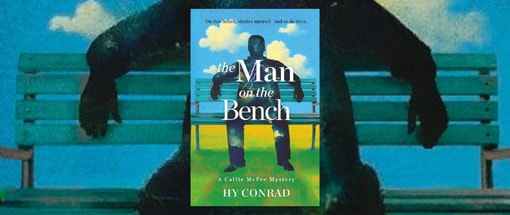
You never know who you might pass everyday, or how they might change your life. During her evening runs, Austin reporter Callie Lee, always stops to chat with Barney, a homeless man who spends his days on the same park bench.
What starts as a simple friendship soon trunks into something much bigger when Barney is found dead, leaving Callie, and her detective brother, determined to find out who he really was, and why someone wanted him gone.
Written by Monk screenwriter Hy Conrad, The Man on the Bench is a mystery that pairs an intriguing investigation with a cast of memorable characters.
Read on for an exclusive excerpt from the novel below.
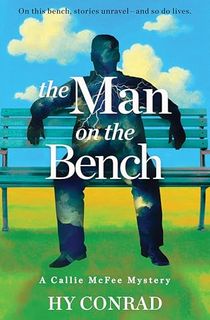
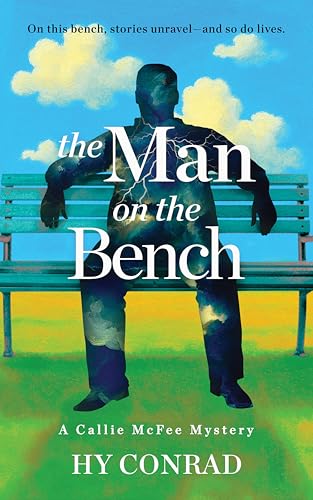
The Man on the Bench: A Callie McFee Mystery
Chapter One
Every weekday after work, Callie would get in her car and drive to her evening run. The hike-and-bike trail wasn’t all that far from the Free Press offices, but she somehow preferred to walk to her RAV4, maneuver through Austin traffic and search for a parking spot. It reminded her of an old college friend. Jackson loved hiking. He would tromp through the woods for hours but loudly complained when he drove up to a popular trailhead, couldn’t find a close-enough parking spot and had to walk there. She once tried explaining the irony of this complaint, but Jackson refused to be amused.
Her route, once she began running, took her through a waterfront park, with a loop that led back and forth across a graceful pedestrian bridge. This was all part of her attempt to cut back on her drinking. If she didn’t get home to her empty house until later, she reasoned, then there would be less temptation to sit in front of the TV and finish of a bottle of wine.
Tonight, on her first trip across, she thought about Barney. He would be waiting. As she came closer, Callie slowed her pace to a brisk walk. This was, she had to admit, the highlight of her day.
Barney was there, as always, his arms spread across the back of the bench, as if reserving her spot. She’d first noticed him about a month ago – same time, same place – in the depth of an Austin cold snap, bundled up in a thin coat. Her first impression was that here was a homeless man, between middle-aged and old, a mellow soul, observing the flow of joggers and walkers and cyclists. There was no donation cup, she noted. But he smiled warmly as she passed by, and the next day, when the wind was a little stronger, she stopped. On an impulse, she handed him her Starbucks card that probably had a week’s worth of lattes on it. He accepted it graciously and they exchanged a few words.
This evening, Barney scooted over, leaving her plenty of room. “Callie, hello.” He took a red handkerchief out of the pocket of his coat, the same handkerchief he’d been using for the past week, and noisily blew his nose. Ever since the first buds began peeping out, he’d been suffering from what he said were spring sniffles. “Sorry.”
“No problem,” Callie said then settled in on the far side of the bench, just to be safe.
"Thanks for stopping. I like when you stop and chat.”
“Even when I don’t, just seeing you here makes me happy.” This was true. Each time she found Barney in his usual spot she felt a little better about life. “All’s right with the world, as they say.”
Barney folded the handkerchief and returned it to his coat. “Quoting Browning to me, huh?”
“From Pippa Passes,” she said, just to prove that her reference to this snippet of Victorian verse was intentional and not a random cliché. She was regularly surprised at Barney’s breadth of knowledge. How did he ever get here, she wondered, this educated, sober man with a short, scraggly beard, a bit of a paunch, a good mind and a dazzling smile? If someone just gave him a shave, a bath and a haircut, he could fit in anywhere. “Do you have everything you need?”
“I had lunch over at Angel House.” He patted his stomach. “Soup and lasagna. Very filling. I have a little put away for later. A little cash, too.”
“Oh, good.” She had never inquired about how Barney kept body and soul together, how he cleaned himself and where he slept. She assumed he spent the nights in a shelter, but it was just a guess. It seemed too intrusive a thing to ask. “Just be careful.”
“Always careful.” Then he leaned in her direction and whispered. “So, how was your dad’s birthday? You were racing off last night and didn’t stop long.”
“Well… it was an eventful evening.”
“Eventful? Uh-oh. That doesn’t sound good.”
The corners of her mouth turned up. “It was our own fault. He’d been having trouble lately.”
“You were telling me.”
“There were a couple days in a row when his mind was fuzzy. And he slept a lot. So, we took a chance. We decided not to plan anything, even though we’d told him – my brother told him – that we were throwing him this big bash of a party. I don’t know why he promised him that. So, on Dad’s birthday, being yesterday… It was somewhere around noon when it happened. Out of the blue…”
“I can see.” Barney’s shoulders began to shake in a near-silent display of mirth. “I can see where this is going.”
Callie reached across and nudged his shoulder. “You got it. Dad’s mind was as clear as a bell.” She imitated his gruff, aging Texas drawl. ‘When’s my party, goddammit? Who’s all coming? Is the Governor coming?"
Barney kept chuckling. “So, what did you do?”
“My brother and I were both at work when we got the call.” She waved her hands as if to erase her words. “I don’t know why I’m telling you this. Forget it.”
The man on the bench just smiled and waited. That was part of his method, she realized, to stay quiet and let you proceed at your own pace, confessing more than you ever intended.
“It was Gil’s idea. Daddy’s number two. Gil can solve anything.”
He prodded her ever so slightly. “You mentioned this Gil before.”
“Gil is very savvy when it comes to manipulating people.
The odds were good that Daddy’s clear-headed spell might last several days, so there would be hell to pay if we didn’t throw this party.”
“So, again. What did you do?”
“Gil did it. He sent out reminders. Dozens of them. The Mayor, bigwig CEOs. All of Daddy’s old cronies. ‘Don’t forget
tonight. Buddy is so looking forward to seeing you.’” She smiled at yesterday’s memory. “You should have seen the flurry of panicky replies. ‘Of course we didn’t forget.’ Or ‘My idiot assistant must have lost the invitation.’ And then Gil would follow up with some extra bait. Personalized. ‘You know the Governor may be here,’ or ‘Too bad you can’t make it. The UT football coach really wants your opinion on next season."
"Very tempting bait,” He showed off a toothy smile. “Did anyone show?
“A surprising number did. Maybe half. Gil got a last-minute bartender and a few servers. And Sarah worked all afternoon. Every possible leftover in every freezer was cut up and repurposed into some sort of appetizer, all without the use of the
microwave, which was… pretty much out of commission.”
Barney sensed there was more to this part of the story. “What happened to the microwave?”
Callie sighed. “Yesterday morning, Dad tried to open the door while it was still heating up his coffee. The door was locked, of course, but he got angry and kept pulling until he broke off the handle. The only microwave in the main house.”
“Is it plastic? You could just glue it back on?”
“That’s exactly what Dad did.”
“Great minds think alike.”
“I hope not. Our brilliant father superglued the handle on. Then he forgot what he was doing and wound up gluing the entire door to the machine. It’ll be a few days before the new one gets installed. Meanwhile…” She waited until Barney stopped chuckling. “Meanwhile, Gil pulled off a last-minute birthday cake and I emptied out a flower shop on my way home. My brother got the Police Chief and two federal judges to change their evening plans.
Barney was impressed. “All those movers and shakers, scuttling around like nervous chickens. I love it.”
“That’s my father’s world. Used to be his world,” she corrected herself. Used to be.
“Did he have a good time?”
“He had a glorious time. He opened all the regifted presents and laughed at everyone’s stale jokes. Just like the old
days. When we saw Daddy finally getting tired and a little confused, Gil managed to set off the fire alarms.”
"This Gil’s a clever man.”
“The Fire Chief was there, and even he couldn’t figure out how to turn them off. The party emptied out fairly quickly after that.”
Barney steepled his fingers in thoughtful consideration.“Your daddy must really miss it, being the center of attention.”
He does,” she had to admit. “I need to remember that. It’s not just taking care of him and keeping him out of trouble.
It’s taking care of the person he used to be… And still can be on a good day.”
Callie had been protecting her father for over a year. Only a handful knew of Buddy McFee’s growing dementia. And
now, for some inexplicable reason, she had shared it with Barney, last name unknown. The most famous power broker
in Texas, a man who could have easily become governor, a man who proved his commitment by naming his only son States Rights when the birth coincided with a particularly thorny legal battle with the federal government – that was Lawrence “Buddy” McFee. This old-school politico who’d been entrusted with decades of prominent scandals and secrets, was losing his grip on reality, capable of blurting out anything to anyone at any time. And a homeless man on a park bench knew.
For some time, Callie had needed to share her situation with an outsider, someone kind and impartial and willing to listen. She had no qualms about going to a therapist. She’d used one in the past. But any therapist in Austin would know the cast of characters and have a preexisting point of view. Plus, there was always the chance that a therapist, even when
bound by confidentiality, would let the juicy news slip. Barney, on the other hand… Who would he tell?
“Callie, you made my day. I think I’d like your father. Maybe I’ll get to meet him sometime.”
I think he’d like you, too.” Callie stood up from the bench and began to stretch, not wanting to let her muscles cool off too much. “You remind me of him. He was always easy to talk to.”
“Is that right?” Barney tilted his head and pursed his lips. “I take that as a compliment. See you tomorrow?”
It was well after sunset when Callie turned off Hacienda Road, maneuvering between the stone pillars and onto the gravel drive of the McFee family property, otherwise known as the Ranch. She pulled up in front of the two-bedroom gatehouse, a small French chateau fantasy with a mansard roof, dating back to the turn of the twentieth century. The gatehouse was home now, only a hundred yards away from the expansive manse where she’d lived nearly all her life. The gatehouse windows were dark, and she reminded herself to turn on a few lights before leaving in the morning, some welcoming illumination to make the place feel a little less lonely on her return.
She was just getting out of the car when she glanced up the corridor of ancient oaks leading to the main house. Buddy and
Gil must still be up, she thought, as well as Sarah, who always seemed to have something to cook or take care of. The whole
point of moving into the gatehouse had been to maintain a little distance from her father’s life, from her old life, but that’s
not quite what happened.
Four years ago, while holding down her first job in journalism, Callie had inadvertently said the wrong thing to the wrong person, another reporter, which culminated in her father’s resignation as the Texas attorney general. For the next three years, they barely spoke. It was during this period, during her self-imposed exile to Dallas, that she developed her sleep problems and drinking problems.
Things were better now. She was back in Austin, sleeping more and drinking less. She’d been able to help with her father’s situation at home but refused to move back in. She needed the distance, she thought, even just a hundred yards. But more and more she found herself walking through the big door and spending time with Buddy and Sarah and even Gil, a man she’d disliked ever since he began working for her father so many years ago.
Just recently, Gil had installed accent lighting in the rose garden, a secluded patch to the right of the gravel drive. It had been one of her mother’s favorite spots and Buddy was spending most of his evenings there, weather permitting, contemplating whatever it was he could still contemplate. He was here tonight, she saw, his large presence filling one of the two iron benches among rose bushes that were just about to bud. For a second, she thought of homeless Barney on his own bench.
As she began ambling toward the garden, she could hear a voice. Was Buddy talking to himself? That was not something he’d ever done, not to her knowledge. But then she saw. Someone was on the other bench, a presence almost as large but not quite as hulking, with a voice that reminded her of a much younger Buddy.
“Hey, Sis.” State glanced her way and toasted with a long-neck of Lone Star.
“Hey. Mind if I join the gentlemen?” Buddy didn’t answer but sat staring down at his hands.
Both Callie and her older brother had inherited their height and Irish red hair from Buddy’s side. Callie kept her curls a little below the shoulders while State kept his short, just long enough to be recognizable as red and wavy. The fourth redhead in tonight’s pack was Angus Two, a middle-aged Irish setter, lying by the edge of the path. He was a recently adopted replacement for Angus One and had never really bonded with anyone. Every now and then, in one of his moods, Buddy would grumble that Angus wasn’t being as affectionate as he’d been twelve years ago.
I brought a six-pack,” State told his sister, “but it may not be cold.” Without waiting for a response, he reached down his side to a cardboard carrier and, in a single motion, pulled out a bottle and tossed it her way. “Heads up.”
Years of experience had taught her how to react to a thrown beer. The bottle went high, but her hand was already raised, and she caught it by the neck, a solid catch, impressing even herself. "Thanks.” A twist of the cap produced a torrent of fizz, and she took her first gulp of alcohol of the day. “Just drop by for a visit?”
Yolanda and the boys went to the movies.” He rolled his eyes. "There are only so many musical cartoons I can take.”
“I’m with you on that.” Callie deposited the cap in her pocket and leaned her free hand on State’s bench. “How’s Dad?”
“Dad, how are you?” State asked the man on the other bench.
Buddy raised his head. “Fine and dandy. Fine and dandy.” He sounded tired, but his voice perked up when he saw his daughter. “Calista. Good of you both to come.”
“No problem. You feeling okay?” It was always a tap dance, trying to gauge her father’s frame of mind. She looked to State for a hint.
“Dad was just going on about his birthday. Weren’t you, Dad?”
Callie felt a rush of relief. “That was some party, wasn’t it?”
“Some party,” Buddy echoed. “Right. We need to have us some party, right? Nothing fancy, but everyone’s gotta be there – Mayor, Governor. I can just see it, clear as day.
Callie held her tongue. Of course you can see it, she thought. Because we already did it.
State offered an exasperated grin. “I tried telling him the party was last night, but Dad was too smart for me, weren’t you, Dad.”
You don’t think I’d remember my party? My own goddamn party?” He said it with bluster, but she could tell that he half believed his son. “Ridiculous.” It must have seemed easier to try to bully them into his version of reality than to accept the truth.
If it had been earlier in the day, Callie might have brought out her phone and shown him a few of the photos she’d taken last night. But she was tired and wanted to finish her beer and maybe have a second.
As her father raised his voice and continued to insist on their ridiculousness, Callie did bring out her phone.
She texted Gil, assuming that he was in his own apartment at the back of the house, all settled in. He texted her back almost immediately.
Within five minutes, Gil Morales joined them in the rose garden, wearing dark comfy pants and a robe. A short, compact man in his late forties, Gil had long ago hitched his career to Buddy’s, through thick and thin, the sublime and the hellish, so entangled that they seemed like two sides of the same coin. Gil made no complaint about his interrupted evening. In fact, he apologized. “Sorry if he’s been misbehaving,” he whispered to his employer’s children. Then he turned and raised his voice. “Now, Buddy, old buddy, I think it’s time for us to get to bed. Don’t you think?”
Buddy renewed his tirade about the party but with less conviction. “Let’s talk about it tomorrow,” Gil interjected calmly every time the older man stopped for air. At some point, State helped pull Buddy to his feet. “Thanks for looking after him,” Gil whispered. “C’mon, boss.”
The younger McFees watched as the men, followed by Angus Two, wound their way under the canopy of live oaks and through the doorway of the cavernous house. State took a deep breath and shook his head. “Why the hell do we kill ourselves? Why the hell? We knew he was just going to forget.”
Callie had to agree, but… “But he’ll remember again, and he’ll love it. And in the long run…” Her tone turned wistful.
“I don’t know. Maybe we do these things for ourselves, just as much. You gotta admit, it makes a good family story. One of so many.”
“Yeah. Maybe,” State muttered. “Until all of us go gaga and forget everything.
“Always a possibility. You want to come in for another beer? I’ve got some cold ones.”
State looked like he was about to accept, but then his phone rang. He checked the screen. “It’s work.” He took a few steps away while Callie took a few steps in the other direction. State’s job made the need for privacy a reflex, and she understood.
Callie tried not to listen. Whatever it was, it sounded serious. She had spent time working with her brother – he as a homicide detective, she as a reporter – and she was glad not to have to deal with that kind of trauma on a daily basis. She didn’t know how he could handle it.
After a minute or so, State lowered his phone and turned her way. “Do you know why some homeless man would be carrying around your name in his pocket?”
“Excuse me?” She knew who he meant, but that didn’t make the situation any clearer. “He’s carrying my name in his pocket?”
“Who is this guy?”
“He’s Barney. I don’t know his last name.” Callie waited while he relayed the information on the other end. “Someone I talk to in the park. Is he all right? Tell me he’s all right.” She watched as her brother adopted his professional, sympathetic face, making her heart go suddenly cold. “No. Please, no.”
“I’m so sorry, Callie, but your friend is dead.”


